Orthopedic Surgeon vs. Chiropractor: Which One Do You Need?
Compare an orthopedic surgeon vs. chiropractor to treat your joint or back pain. Learn which specialist is right for your injury and how to find the best care.

Finding the right professional for joint or back pain can feel like navigating a complex maze. When your mobility is at stake, the choice between a surgeon and a chiropractor is more than just a matter of preference: it is about choosing the right level of care for your specific injury.
This guide was written for real people who want to move past the confusion and get back to their daily lives. We are demystifying the differences between these professionals and helping you identify exactly which type of specialist you should search for today.
Orthopedic care, explained
Orthopedic care is the branch of medicine focused on the musculoskeletal system. This includes your bones, joints, ligaments, tendons, and muscles. While many people think of "bones" when they hear orthopedics, the field covers everything that allows your body to move.
Managing pain and restoring function are the primary goals of any orthopedic specialist. However, the path they take to achieve those goals differs significantly depending on their training and the tools they are licensed to use.
Orthopedic Surgeon vs. Chiropractor: The core differences
Choosing between an orthopedic surgeon and a chiropractor often comes down to the severity and nature of your condition.
An orthopedic surgeon is a Medical Doctor (MD) or Doctor of Osteopathic Medicine (DO). They have completed over a decade of formal education, including medical school, a five-year residency, and often a specialized fellowship. They are trained to diagnose structural issues and can provide a full spectrum of treatments: ranging from prescription medication and specialized injections to complex surgical repairs and joint replacements. If you are searching for an orthopedic surgeon near me, you are likely looking for a definitive diagnosis of a structural problem.
A chiropractor holds a Doctor of Chiropractic (DC) degree. They are not medical doctors, but they are highly trained specialists in spinal health and manual adjustments. Their approach is strictly non-invasive and non-surgical. They focus on the relationship between the body's structure: primarily the spine: and its function. Chiropractic care is often a choice for those seeking conservative, hands-on management for mild to moderate back or neck discomfort without the use of medication.
A third professional often enters this conversation: the physiatrist. These are medical doctors who specialize in physical medicine and rehabilitation. They offer a middle ground, providing non-surgical medical treatments like injections and advanced physical therapy coordination for complex pain.
Understanding orthopedic sub-specialties
Not every "bone doctor" treats every part of the body. Most top-tier specialists focus on a specific area to provide the highest level of expertise. When you are looking for an orthopedic doctor near me, knowing which sub-specialty you need will save you time and ensure you get the right treatment.
| Sub-Specialty | Focus Area | Common Conditions Treated |
|---|---|---|
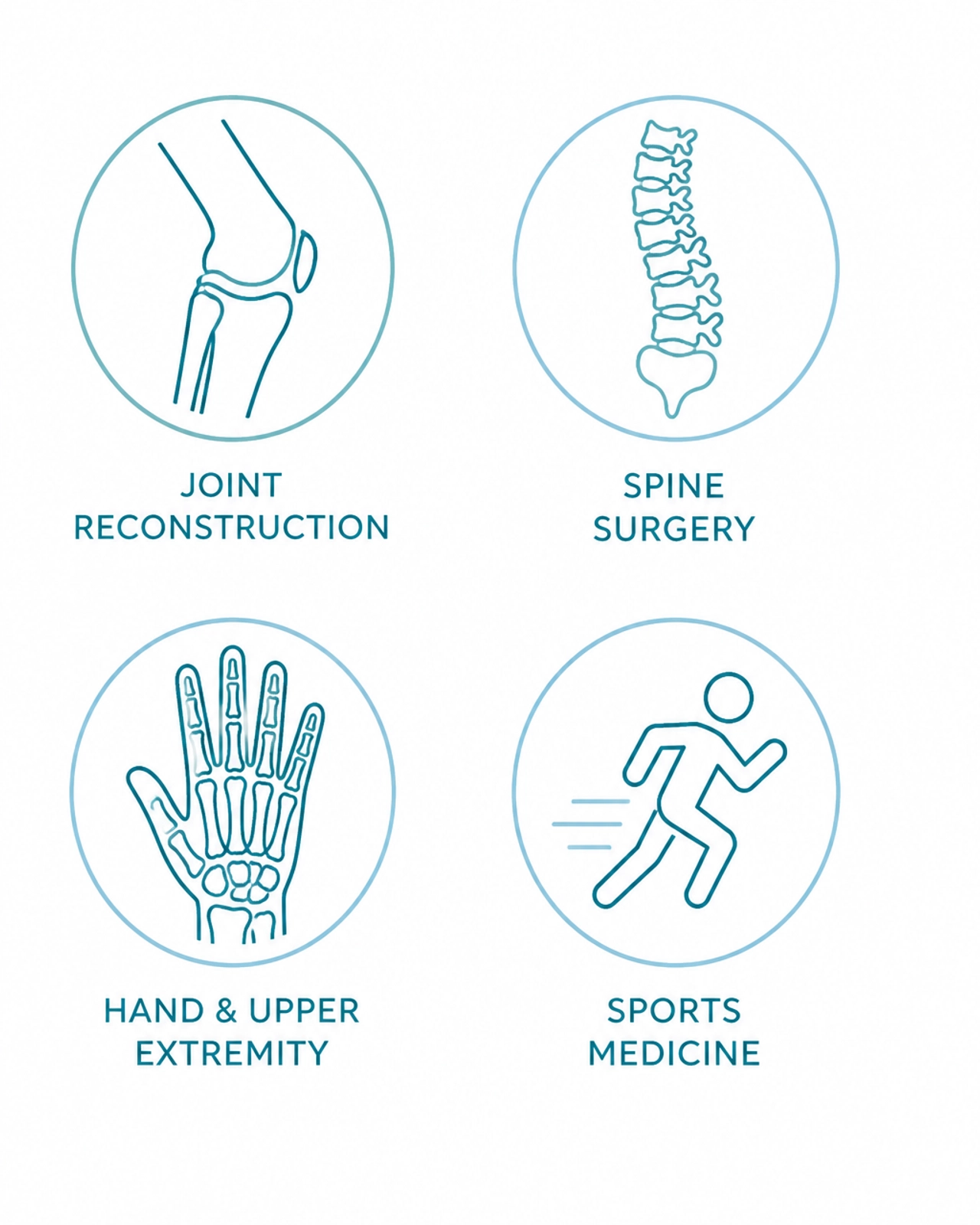
| Sports Medicine | Athletic injuries and overuse | ACL tears, rotator cuff injuries, meniscal tears |
| Joint Replacement | Degenerative joint disease | Severe arthritis of the hip or knee |
| Spine Surgery | Neck and back | Disc herniations, scoliosis, spinal stenosis |
| Hand & Upper Extremity | Shoulder to fingertips | Carpal tunnel, trigger finger, wrist fractures |
| Foot & Ankle | Lower leg and foot | Bunions, Achilles tendonitis, ankle instability |
| Pediatric Orthopedics | Children and adolescents | Clubfoot, growth plate injuries, limb deformities |
Navigating the specialties
Identifying the right specialist depends on the location of your pain.
- Sports Medicine Doctor: If you injured yourself while running, playing a sport, or at the gym, a sports medicine doctor is your first stop. They focus on returning patients to their peak activity levels as quickly as possible.
- Hip Replacement Specialist: For those dealing with chronic, bone-on-bone pain that makes walking difficult, a hip replacement specialist or joint specialist can evaluate if a total or partial replacement is necessary.
- Knee Doctor: Searching for a knee doctor near me is common for both sudden injuries (like a pop in the joint) and long-term wear and tear.
6 Signs you need to see an orthopedic surgeon
Knowing when to skip the ice pack and see a professional is crucial for preventing long-term damage. If you experience any of the following, an evaluation by an orthopedic doctor near me is recommended:
- Difficulty performing daily tasks: If walking the dog, climbing stairs, or reaching into a cupboard causes significant pain, the issue is likely structural.
- Chronic pain (3+ months): Pain that persists despite rest, stretching, and over-the-counter anti-inflammatories needs a professional diagnosis.
- Decreased range of motion: Feeling "stiff" is one thing, but being unable to fully straighten your arm or rotate your shoulder indicates a joint or ligament issue.
- Instability while walking: If your knee feels like it might "give out" or you are frequently tripping, you may have a ligament tear or joint instability.
- Numbness or tingling: These are often signs of nerve compression. If you feel "pins and needles" radiating down your arm or leg, see a spine or hand specialist.
- Deformity after injury: If a joint looks "off" or a bone appears misaligned after a fall, seek immediate orthopedic care to rule out a fracture.
Finding the best orthopedic surgeon for your needs
The "best" surgeon is not just the one with the most diplomas: it is the one who accepts your insurance, has experience with your specific condition, and makes you feel heard.
Using the Medical Online Directory simplifies this search. Instead of calling dozens of offices, you can use advanced filters to narrow down your options in seconds.
Searching by insurance and location
Health care is expensive, and nobody wants a surprise bill. Filtering by your specific insurance plan: whether it's Aetna, Blue Cross Blue Shield, or Medicare: ensures that you only see providers within your network. You can also view results in a map view to find the most convenient office locations.
Checking "New Patient" status
There is nothing more frustrating than finding the perfect doctor only to learn they aren't taking new patients for six months. Our directory includes "Accepting New Patients" indicators, allowing you to prioritize doctors who can see you sooner.
Reading verified reviews
We list over 12,966 patient reviews with a 4.8★ average rating. These are real experiences from real people. Look for reviews that mention the doctor's bedside manner, the cleanliness of the facility, and the clarity of their explanations.

Questions to ask before you book
Before you commit to a consultation, prepare a few questions to ensure the doctor is the right fit. This proactive approach ensures you maximize your time during the visit.
- "How many procedures of this type do you perform annually?" Experience matters, especially for specialized surgeries like hip replacements or ACL repairs.
- "What are my non-surgical options?" A best orthopedic surgeon will always explore conservative treatments: like physical therapy or injections: before suggesting surgery.
- "Do you offer telehealth consultations?" For initial reviews of imaging (like X-rays or MRIs), a telehealth visit can save you a trip to the office.
- "What is the estimated recovery time?" Knowing if you need two weeks or two months off work is essential for planning your life.
How we simplify your healthcare journey
At Medical Online Directory, we believe that finding a doctor should be the easiest part of getting better. Our platform is designed to remove the friction from the healthcare system.
- Symptom-based matching: Not sure if you need a hand specialist or a general orthopedist? Use our symptom filters to find providers who treat your specific pain.
- Multilingual options: Search for providers who speak your preferred language to ensure nothing is lost in translation.
- Transparent cost guides: We provide estimated visit costs to help you budget for your care: Free, no obligation.
Staying on top of your recovery
Recovery is an active, ongoing process. Once you have found your specialist, following their rehabilitation plan is the key to success. This often involves working closely with physical therapists to rebuild strength and flexibility.
Whether you are navigating a recent injury or staying ahead of chronic arthritis, the right information is your best tool. Don't wait for the pain to become unbearable. Taking 60 seconds to search our directory today could save you months of discomfort.
Ready to find relief?
Search for an orthopedic specialist near you : it takes 60 seconds and is completely free to use.
Found this article helpful?