Specialist Search, Explained: How to Find Specialists Near You
Search for top rated cardiologists near me and learn how to verify board certifications, sub-specialties, and patient reviews for high-quality heart care.

Finding the right medical expert shouldn't feel like a full-time job. When you are dealing with a specific health concern: whether it is chronic back pain, a persistent skin rash, or a new heart health goal: Finding a specialist who understands your unique needs is the first step toward feeling better.
Navigating the healthcare system can often feel like walking through a maze without a map. This guide is written for real people who need clear, actionable steps to find high-quality care without the stress. We believe that accessing healthcare should be simple, transparent, and fast.
Choosing your care level
Understanding when to see a specialist versus staying with your primary care provider (PCP) is the foundation of efficient healthcare. Your PCP is your health quarterback: they manage your overall wellness, handle routine screenings, and treat common illnesses. However, there are times when a "generalist" approach isn't enough.
Seeking specialized care is usually necessary when a condition becomes complex, chronic, or requires diagnostic tools that a standard clinic doesn't house. For example, while a PCP can treat a basic cough, a pulmonologist: a lung specialist: is the expert you need for managing long-term asthma or respiratory disorders.
Moving to a specialist means you are accessing focused expertise. These professionals have spent years: often a decade or more: studying a specific organ system or disease type. By identifying the right expert early, you reduce the time spent on "trial and error" treatments and get straight to the solutions that work.
A simple rule helps here: start with your PCP when your problem is new, mild, or broad. Move toward a specialist when the issue keeps coming back, gets worse, affects daily life, or has already been treated without much progress. If headaches are now happening every week, if joint pain is stopping you from working, or if stomach symptoms continue after basic treatment, that is usually a sign to look deeper.
It also helps to think in categories. A dermatologist handles skin, hair, and nail concerns. A cardiologist focuses on the heart. An orthopedist treats bones, joints, and injuries. An endocrinologist helps with hormone-related issues such as diabetes or thyroid problems. Knowing the likely category before you search saves time and keeps the process less overwhelming.
You do not need to diagnose yourself before booking care. You just need a reasonable starting point. If you are not sure which specialist fits, use your symptoms as a guide and ask your PCP, urgent care clinician, or insurer's member services line where to begin. For example, numbness in the hand might lead you to a neurologist or an orthopedic hand specialist. Ongoing reflux might point you toward a gastroenterologist. A changing mole may call for a dermatologist quickly.
This step matters because the wrong care level can create delays. Some people wait too long with a specialist-level problem. Others book with a specialist for something a PCP could have handled faster. The goal is not perfection. The goal is choosing the next best step with the information you have right now.
Navigating the referral path
Before you start your search for "specialists near me," you need to know if your insurance plan requires a "permission slip" to see one. This is known as a referral.
Managing referrals is a key part of the process for many patients, especially those with HMO (Health Maintenance Organization) plans. In these systems, your primary doctor must evaluate you first and then formally recommend a specialist within your network. Without this step, your insurance company might refuse to pay for the visit: leaving you with an unexpected bill.
If you have a PPO (Preferred Provider Organization) plan, you often have more freedom. You can typically "self-refer," meaning you can find a specialist on your own and book an appointment directly. Regardless of your plan type, it is always a smart move to ask your primary doctor for their recommendations. They often have professional relationships with local experts and can point you toward someone whose communication style matches your own.
The practical part is where many people get stuck. A referral may need to include the specialist's name, office location, specialty, and reason for the visit. Some plans also require the referral to be active before your appointment date. That means you should not assume "my doctor said it is fine" is the same as "insurance approved it." Those are not always the same thing.
A good script can make this easier. Call your PCP office and ask: "Can you confirm whether my referral has been submitted, approved, and sent to the specialist's office?" Then call the specialist and ask: "Do you have my referral on file before I come in?" Two short calls can prevent a lot of back-and-forth on appointment day.
If your referral is delayed, do not panic. Ask the specialist's office if they can hold your appointment while paperwork is being processed. Many offices deal with this every day. If you are seeing a specialist for something urgent, explain the situation clearly. Offices often have cancellation lists or can guide you on what to do next.
It is also worth asking how long the referral remains valid. Some referrals cover only one visit. Others allow several visits over a set period. This matters if you expect follow-up care, physical therapy, imaging, or repeat testing. Knowing the details up front helps you avoid interruptions later.
Matching your insurance plan
One of the biggest hurdles in healthcare is the "out-of-network" surprise. Finding a brilliant doctor is only helpful if you can afford to see them. This is why insurance matching is the most critical technical step in your search.
Verifying coverage involves more than just checking a logo on a website. Insurance networks change frequently: doctors join and leave plans every month. When you use the Medical Online Directory, you can filter specifically by your insurance provider and even your specific plan name. This narrows your list down to only those providers who are currently "in-network," helping you keep your out-of-pocket costs as low as possible.
Always remember to double-check during your first phone call. A quick question like, "Are you still an in-network provider for my Blue Cross Blue Shield PPO plan?" can save you hundreds of dollars. It takes 60 seconds and provides total peace of mind.
There are a few more details worth checking too. Ask whether the doctor is in-network, whether the office location is in-network, and whether common services tied to the visit are covered. A specialist appointment can involve more than the doctor alone. Lab work, imaging, procedures, and even a hospital-based facility fee may be billed separately.
For example, you might find an in-network orthopedic specialist, but the imaging center they use may not be covered at the same level. Or a dermatologist may be in-network, but a cosmetic-style service or certain biopsy-related lab charges may be handled differently by your plan. The more specific your questions, the fewer surprises later.
Here are a few useful questions to ask:
- Is this provider in-network for my exact plan?
- Do I need a referral or prior authorization first?
- What is my specialist copay or coinsurance?
- Will any testing done during the visit be billed separately?
- Is telehealth covered the same way as an in-person visit?
If you have a high-deductible plan, ask what you may owe before the deductible is met. If cost is a concern, ask the office for a self-pay estimate, a range for common visit charges, or payment options. Clear numbers help you compare providers in a real-world way: not just by distance or star rating, but by what fits your budget today.
Evaluating credentials and reviews
Once you have a list of in-network doctors, how do you choose the "best" one? This is where data meets human experience.
Checking credentials is the objective part of the search. You want to ensure the doctor is board-certified in their specialty. Board certification means the physician has gone above and beyond basic licensing to pass rigorous exams and maintain ongoing education in their field. It is a gold standard for clinical excellence.
Reading patient reviews provides the subjective, human perspective. While one or two negative reviews are common for almost any business, look for patterns in the feedback. Are patients consistently mentioning that the doctor listens well? Is the office staff described as helpful? Are wait times reasonable? On the Medical Online Directory, we feature over 12,966 patient reviews with an average rating of 4.8 stars, giving you a clear picture of what to expect before you walk through the door.
It helps to separate "clinical quality" from "experience quality." A great specialist should be qualified and current in their field, but the patient experience matters too. If a doctor is excellent but impossible to reach, never explains next steps, or regularly runs hours behind, that affects your care in a real way.
Look closely at the details inside reviews. Comments like "explained things clearly," "didn't rush me," and "gave me a practical plan" often matter more than generic praise. This is especially true when you are dealing with a condition that may require several visits. Good communication becomes part of the treatment.
At the same time, read reviews with balance. One person's frustration about parking may not tell you much about the doctor. A complaint about a long wait during flu season may be understandable. What you want are repeat signals. If dozens of patients mention poor follow-up, billing confusion, or feeling dismissed, pay attention.
You can also compare specialists based on fit. A parent looking for a pediatric specialist may care a lot about bedside manner and scheduling flexibility. Someone managing a chronic condition may prioritize long-term care planning, fast portal messages, and coordination with other doctors. The right choice is not only about who is "top rated." It is about who is right for your situation.
Utilizing advanced search filters
The days of flipping through a thick paper directory are over. Modern healthcare search should be as easy as ordering a meal or booking a flight.
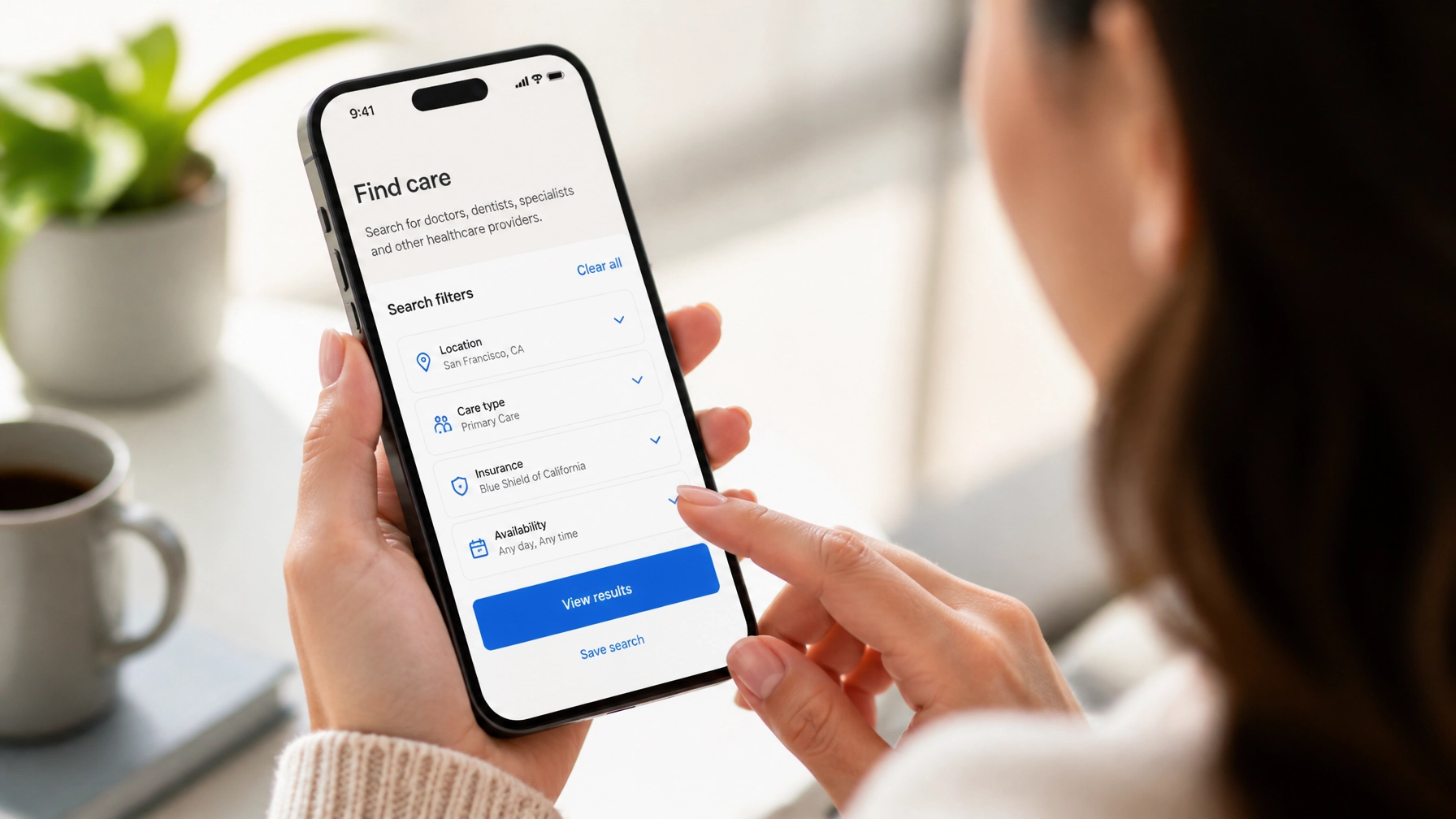
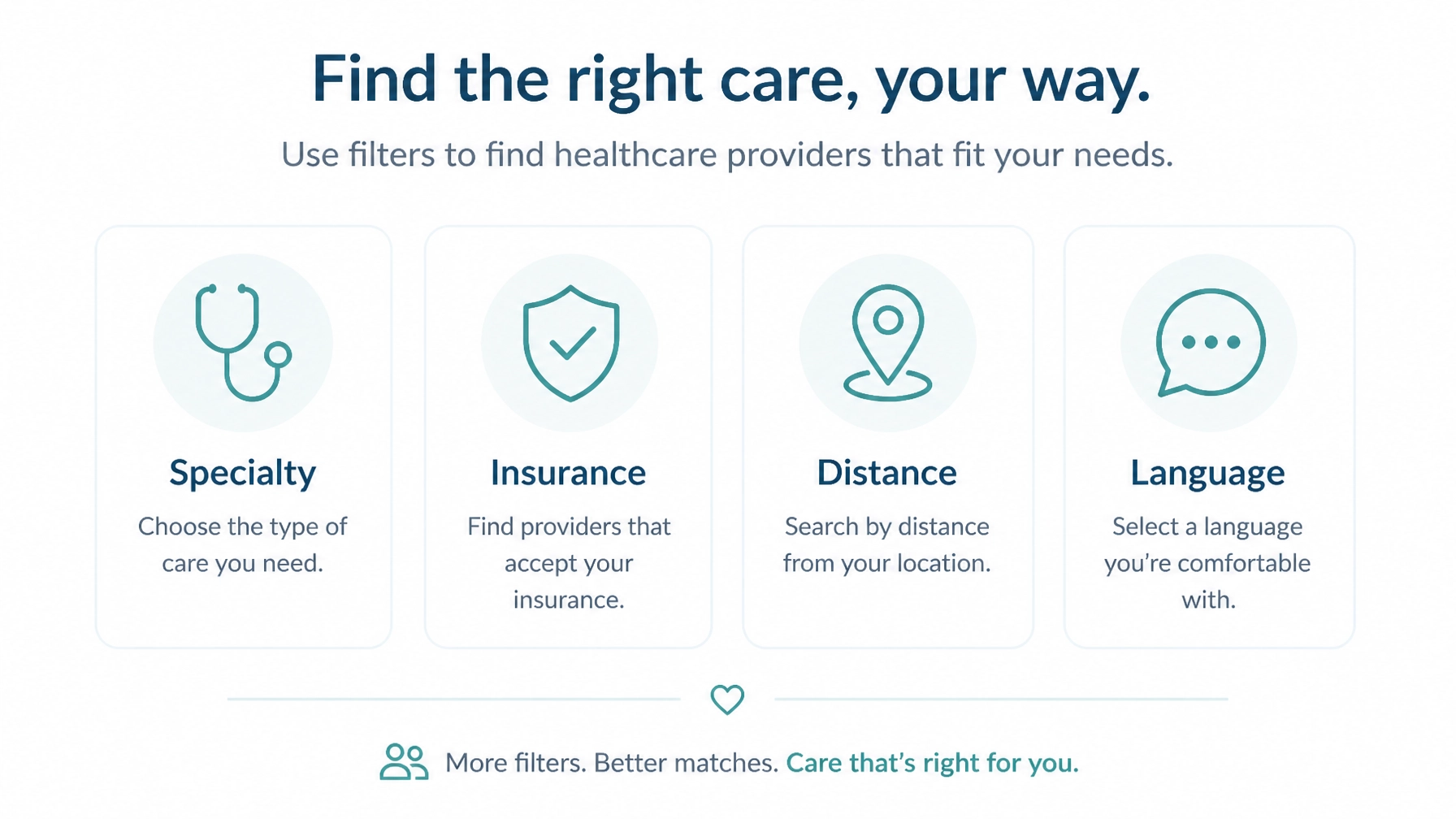
Simplifying your search is our primary goal. We provide advanced filters that go beyond just "type of doctor." You can refine your results by:
- Distance: Use the map view to see exactly how far you'll need to travel.
- Language: Find a provider who speaks your native tongue for clearer communication.
- Availability: Filter for doctors who are currently accepting new patients: avoiding the frustration of a "closed" practice.
- Telehealth: Identify providers who offer virtual visits for those days when you can't leave the house.
The best way to use filters is to narrow in stages. Start broad with the specialty and your insurance plan. Then add practical filters that matter most to your life: maybe evening availability, telehealth, or a short driving distance. If you filter too aggressively at the start, you might hide strong options.
For example, say you need a cardiologist. First filter by cardiology and your insurance. Then compare results by distance and reviews. Next, check who is accepting new patients. Finally, decide whether telehealth matters for your first consultation or follow-up visits. This step-by-step approach keeps the list useful instead of overwhelming.
Language filters deserve special attention. Healthcare visits can be stressful, and even simple instructions can feel harder to follow when they are not in your preferred language. If clear communication matters for you or a family member, this is not a minor convenience. It is a real quality-of-care issue.
Map view can also reveal useful things that a simple list does not. A provider who is technically "nearby" may still be difficult to reach because of traffic, parking, or transit limits. Looking at the map gives you a more realistic sense of what appointment day will feel like.
If you are helping an older parent, a child, or someone with limited mobility, practical filters become even more important. A slightly lower-rated office that is easy to reach, accepts new patients, and has a smooth process may be the better choice over a harder-to-access clinic across town.
Exploring telehealth options
Staying home while receiving expert care is no longer a luxury: it is a standard part of modern medicine. Telehealth is an excellent option for initial consultations, follow-up appointments, or discussing test results.
Choosing telehealth can save you hours of travel time and the stress of a busy waiting room. Many specialists: especially those in mental health, dermatology, and neurology: can provide high-quality care through a secure video link. When you search for specialists, look for the "Telehealth Available" badge on our platform. This indicator helps you prioritize convenience without sacrificing the quality of your care.
Telehealth works especially well when the visit is conversation-based. That includes reviewing symptoms, discussing treatment options, checking in on medication side effects, or going over next steps after testing. It can also be useful for deciding whether you need to come in at all.
That said, telehealth is not always the complete answer. Some specialties rely on hands-on exams, imaging, procedures, or vital signs that cannot be done over video. A virtual dermatology visit may help with a visible rash, but an in-person appointment may still be needed for a full skin exam or biopsy. A neurology follow-up might work well online, while a first visit for new weakness or severe symptoms may need in-person care.
Before booking, ask a few basic questions:
- Is this type of visit appropriate for telehealth?
- Will I need an in-person follow-up after the video visit?
- What app or link do I need to join?
- Can I upload photos, records, or test results in advance?
- Is the cost the same as an office visit?
A little preparation improves the experience. Test your internet connection, sit in a quiet and well-lit room, and keep your medication list and questions nearby. If the specialist needs to see a symptom: such as a rash, swelling, or range of motion issue: gather anything that helps show it clearly. Small steps like these make the visit smoother and more productive.
Simplifying the search with Medical Online Directory
We built Medical Online Directory to be your steady guide in an often confusing industry. We believe that everyone deserves access to verified, high-quality medical information without the jargon.
Connecting with a provider through our platform is a low-friction experience. You can browse our list of 37+ verified providers across 12+ medical specialties in seconds. Whether you need a cardiologist, a pediatrician, or a physical therapist, our map view lets you see exactly who is nearby.
Our platform is:
- Free, no obligation: Search as much as you want without creating an account.
- Transparent: View estimated visit costs and verified patient ratings.
- Comprehensive: Access facilities and individual doctors in one place.
We also designed the experience for real-life decision making. Most people are not searching for a specialist because they are curious. They are searching because something hurts, a symptom will not go away, a child needs care, or a follow-up has become urgent. In those moments, speed and clarity matter.
Instead of opening dozens of tabs and comparing scattered information, you can keep the core details in one place. That means less second-guessing and less time spent trying to confirm the basics. You can focus on the questions that actually matter: Does this provider treat my issue? Do they take my insurance? Can I get in soon? Is the office convenient? Do patients say they feel heard there?
For families, caregivers, and busy adults, this kind of structure makes the process easier to manage. If you are helping a parent find a new specialist after a move, or trying to book around work and school schedules, having filters, map view, and review data together can turn a stressful task into a shorter one.
The goal is simple: help you move from searching to scheduling with fewer obstacles. Healthcare can be complicated enough. Finding the right person should feel clearer.
Preparing for your first visit
You've found the doctor, verified your insurance, and booked the appointment. Now, you need to make the most of your time.
Arriving prepared ensures that your specialist has all the information they need to help you. We recommend bringing a "health folder" that includes:
- A list of symptoms: Describe when they started and what makes them feel better or worse.
- Current medications: Include dosages for any prescriptions, vitamins, or supplements.
- Recent test results: If you had blood work or imaging done recently, bring copies of the reports.
- Your questions: Write down the top three things you want to achieve during the visit.
Being an active participant in your care: rather than just a passive observer: leads to better health outcomes. Don't be afraid to ask for clarification if a term is confusing or if you want to know more about different treatment options.
A little organization can make the visit much more productive. Try writing a short timeline of what has happened so far. Include when the problem started, what has changed, what treatments you already tried, and whether anything helped. Specialists often have limited time on a first visit, so a clear summary helps them see the full picture faster.
It is also smart to bring practical details that people often forget: your insurance card, photo ID, referral paperwork if needed, and the contact information for your PCP or other doctors involved in your care. If you use a patient portal, upload records in advance when possible.
If you feel nervous, that is normal. Many people leave appointments and realize they forgot to ask the one thing that mattered most. A short list on your phone can fix that. Good questions include:
- What do you think is the most likely cause of this problem?
- What tests, if any, do I need next?
- What signs should make me call back sooner?
- What are my treatment options right now?
- When should I expect follow-up?
If you are attending on behalf of a child, parent, or partner, ask whether you can come into the exam room or join by speakerphone. Support matters, and a second set of ears can help you remember instructions later.
After the visit, take a minute before you leave or hang up. Make sure you understand the next step: whether that means scheduling a test, starting a medication, booking follow-up, or watching for changes at home. Clear next steps are one of the easiest ways to feel more in control.

Staying informed and healthy
Finding a specialist is not just a one-time task: it is an ongoing process of managing your health. As your needs change, your care team might change too.
Navigating these transitions is easier when you have a reliable resource at your fingertips. You can learn more about how we work on our About page or find answers to common questions in our FAQ section. Our mission is to keep the "human" in healthcare by making information accessible to everyone.
It also helps to remember that finding the right specialist is sometimes a process, not a single perfect match on the first try. If a doctor is not a good fit for your communication style, scheduling needs, or treatment goals, it is okay to keep looking. That is not being difficult. That is being thoughtful about your care.
As your health changes, your search priorities may change too. Early on, speed may matter most. Later, long-term follow-up, treatment planning, and office responsiveness may become more important. Parents, caregivers, and patients managing chronic concerns often benefit from revisiting their options over time instead of assuming one choice has to fit forever.
Keep a simple record of who you saw, what was recommended, and what happened next. This helps if you need a second opinion, a transfer of care, or a new specialist after moving or changing insurance. It also helps you notice progress: which can be easy to miss when you are focused on day-to-day symptoms.
Finding specialists near you should be the easiest part of your health journey. With the right tools and a clear plan, you can stop searching and start healing.
Ready to find your expert? It takes 60 seconds to start your search. Find a specialist now.
Found this article helpful?